


Akbar’s Balancing Act:Power, Faith, and Pragmatism in Akbar’s Reign

Updated: Apr 11

INTRODUCTION
The reign of Akbar (1556–1605) remains one of the most debated periods in Indian history, particularly for his innovative approach to governance and religion. His policies, including the Ibadatkhana debates, the Mahzar of 1579, and the philosophy of Sulh-i-Kul, raise a crucial question: Were these initiatives a sincere pursuit of religious tolerance or were they calculated measures to consolidate political power?
Examining this question is important because Akbar's reign represents a unique moment in pre-modern history when a ruler sought to transcend religious divides within a deeply pluralistic society. We also get to know the empire-building strategy of Akbar, the challenges of managing diversity, and the interplay between personal beliefs and statecraft.
This paper will delve into the motivations and implications of Akbar's key religious policies. It will explore the purpose and evolution of the Ibadatkhana debates, the significance of the Mahzar as a tool for reconfiguring political and religious authority, and the broader philosophy of Sulh-i-Kul. Through these discussions , the paper aims to evaluate whether Akbar’s policies reflected genuine religious tolerance or were driven by political necessity.
SOURCES
To critically evaluate Akbar’s religious policies, it is essential to first examine the sources that provide insight into his reign. Two significant primary sources for this period are Abul Fazl’s Akbarnama and Badauni’s Muntakhab-ut-Tawarikh. These works present contrasting perspectives, and reflect the ideological and personal biases of their authors.
Abul Fazl’s Akbarnama offers an official account of Akbar’s rule. It portrays him as a visionary leader whose policies were inspired by divine guidance and moral ideals. However, questions have been raised about its objectivity because of Fazl’s own individual biases as well as because it was written under Akbar’s patronage. (Alam 2009, 164). For example, he exaggerates the association of Chishtis with Mughals by portraying it as a very intimate contact. He tries to portray that if Mughals wanted to associate to any dervishes, then it should obviously be Chishtis. This is because he himself was ideologically inclined towards them. Moreover, he does not portray the clashes within the Empire or highlight the bad decisions of Akbar. He dismisses those events by considering them a consequence of “ill advice.” Alam rightly remarks about Abul Fazl:
“He was not a mere chronicler. He had his own philosophy of life and social order, and propounded, promoted, and defended the ideology of this dispensation. He wrote history with a mission.” (Alam 2009, 31)
In contrast, Badauni’s Muntakhab-ut-Tawarikh provides a more critical perspective. As a contemporary of Akbar who initially supported his rule, Badauni became increasingly disillusioned with the emperor’s religious policies. His work reflects this shift. Unlike Abul Fazl, Badauni highlights the opposition Akbar faced from orthodox Muslim scholars and the broader courtly elite, framing his policies as radical departures from Islamic tradition. Moreover, since he was appointed as the imam of Akbar’s new capital, Fatehpur Sikri, he could personally observe the functioning of Akbar’s court, making him an important source to study Akbar’s reign (Habib 2022, 77). However, we need to be aware of his ideological orientations too.
Thus, although both sources are important for studying Akbar’s religious policies, we need to evaluate these sources critically and be mindful of the biases of the authors while analysing them.
IBADATKHANA
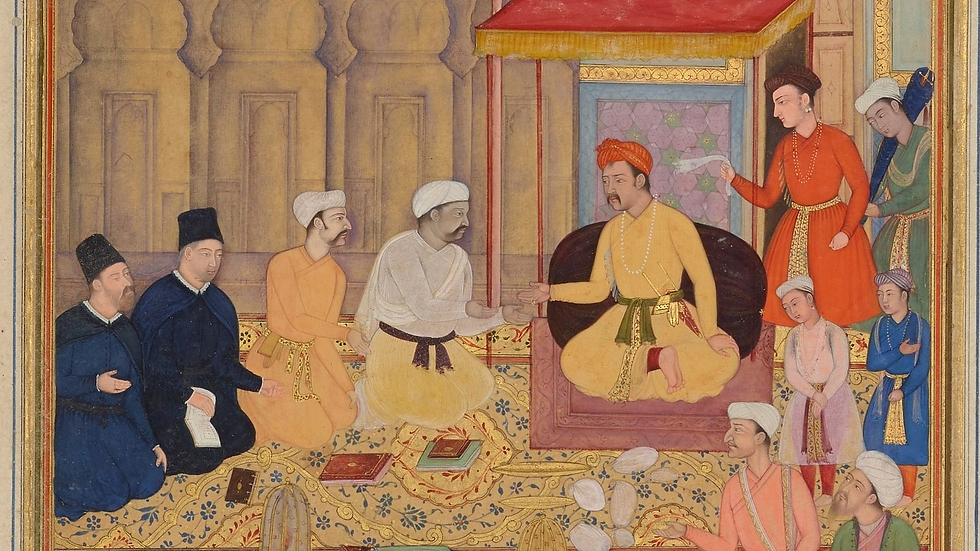
An important element of Akbar’s religious policies was the establishment of the Ibadatkhana, or House of Worship, in 1575 at Fatehpur Sikri.
During the 1570s, Akbar’s empire had expanded significantly, and his focus now turned to religion (Habib 2022, 78). He believed that God had saved him from various wartime adversities. This instilled religious feelings in him, and he began questioning several religious traditions (Moosvi 2010, 171). This created confusion in his mind as to which religious practices to follow and made him apologetic and dissatisfied with his own conduct. As a result, he had fits of depression and melancholy (Khan 1992, 19). Moreover, he wanted to conform to an accepted code of behaviour. This, coupled with his general curiosity about religion, led him to set up a place where theologians of different sects could debate and discuss which religious practices were most justifiable theologically (Khan 1992, 19), (Habib 2022, 78).
Inspired by the model of Sulaiman Kirani’s court, Akbar initially invited only prominent Islamic scholars like Shaikhs and Ulamas to deliberate on matters of theology and jurisprudence. These debates, however, often became heated and divisive, questioning the legitimacy of orthodox interpretations (Smith 1917, 715-716). These debates revealed the limitations of traditional Islamic jurisprudence in addressing the complexities of a pluralistic society.
Thus, recognizing the need for a broader perspective, Akbar expanded the Ibadatkhana to include representatives from other religious traditions, such as Hindus, Jains, Christians, and Zoroastrians. This was a departure from the Mughal court’s earlier religious policies. It was a sign of Akbar’s intellectual openness and commitment to understanding the theological and philosophical foundations of different faiths (Habib 2022, 81). Moreover, Akbar’s active involvement in these debates was notable. He questioned orthodox positions and encouraged frank dialogue between different religious traditions (Smith 1917, 719-720).
However, I believe that these debates were not merely intellectual exercises but were also tied to Akbar’s broader political strategies. Through these debates, he also tried to assert control over religious discourse and establish his authority as a ruler who valued reason and inclusivity.
Thus, we can conclude that while the Ibadatkhana debates were a significant step toward fostering interfaith dialogue, they also laid the basis for Akbar’s later policies, such as Sulh-i-Kul and helped create his reputation as a ruler who sought harmony in a diverse and divided empire.
MAHZAR
The issuance of the Mahzar in 1579 was a pivotal moment in Akbar’s reign, as it reshaped the relationship between religious and political authority. This document was crafted during a period of geopolitical and internal tensions, and it elevated Akbar’s role from that of a conventional ruler to that of a spiritual and judicial authority. It positioned him as the ultimate arbiter in religious matters, above the orthodox ulama and sectarian conflicts within the empire (Kondo 2010, 159).
The geopolitical context of the Mahzar is crucial to understanding its motivations. During the 1570s, the Mughal Empire faced external threats from the Safavid and Ottoman empires due to the Rumi Feud. The Rumi feud was a triangular contest between the Timurids, the Ottoman Turks, and the Safavid dynasty (Buckler 1924, 594). It is important to note that Akbar’s grandfather and father were vassals of the Persian empire. Babur was under the suzerainty of Shah Ismail because he wanted to regain his ancestral territory of Samarqand (Buckler 1924, 596). Similarly, Humayun took refuge from Shah Tahmasp when he was defeated at Delhi (Buckler 1924, 598). Moreover, Akbar’s proclamation as a ruler was recognised by a farman of Shah Tahmasp (Buckler 1924, 601). This created a perception of Mughal dependency on Persian Shi’a hegemony. This association was hated by the Sunni population of Akbar’s empire and led to rebellions by Persian backed factions. Thus, it posed a challenge to Akbar’s authority. The death of Shah Tahmasp of Persia in 1576 further destabilized the region, as it sparked a succession crisis. However, it also created opportunities for Akbar to assert his independence (Buckler 1924, 603-604).
Akbar capitalised on this opportunity. The Mahzar pronounced Akbar as Khalifatu’l-Zaman, which meant Khalifa of the Age. This view was strengthened through the use of Amiru’l-Muminin , as a title for Akbar, which meant the leader of the adherents (Buckler 1924, 606), (Kondo 2010, 161). This separated Akbar from the hegemony of the Persian Shi’a Empire. This break could have brought the Mughal empire under the Turkish Caliphate. However, the proclamation of Akbar as the Khalifa ensured that Akbar’s authority was free from any such influence (Kondo 2010, 162). But to ensure that the Shi’a populace of the Mughal Empire was not agitated, it was worded in a manner that was acceptable from the perspective of Shi’a theology too (Buckler 1924, 606-607).
Domestically, the Mahzar served as a critical tool to curtail the influence of the ulama, who often resisted Akbar’s reformist policies and opposed his increasingly inclusive approach to governance. Akbar realised that the political stability of the empire could only be ensured if he brought the goodwill of all groups of subjects like Hindus, Indian Muslims etc. (Buckler 1924, 605). Thus, the Mahzar kept Akbar as the rightful leader (imam-i 'adil) above mujtahids (those qualified to exercise ijtihad or legal interpretation) (Kondo 2010, 160).
Therefore, it can be said that the Mahzar broke the Mughal Empire free from external powers like Persia and the Turkish Caliphate. Internally, it allowed Akbar to integrate various communities like Hindus and Indian Muslims. It also gave Akbar an upper hand over the orthodox clerics who opposed his reformative policies. Therefore, it redefined the role of the emperor within the Mughal state.
Sulh-i-Kul
The Mahzar of 1579 laid the foundation for Akbar’s evolving religious policies, but it was through Sulh-i-Kul, or “Universal Peace,” that his vision of an inclusive and harmonious empire fully materialized. It was rooted in the Chishti doctrine of wahdat al-wajud, which meant religious synthesis (Moosvi 2010, 173). Sulh-i-Kul emphasized that the reality of the world is all an illusion and, thus, the differences between religions are all insignificant. Therefore, all faiths should be tolerant of each other and maintain peace. (Moosvi 2010, 173).
This philosophy was not just a spiritual idea but also a pragmatic approach to governing the diverse empire. Sulh-i-Kul emerged as a response to the limitations Akbar encountered during the Ibadatkhana debates and the Mahzar. While the Mahzar granted Akbar authority over religious interpretations, it did not allow him to establish a distinct ideological framework. He could only choose one of the interpretations already given by a religious sect (Habib 2022, 82). This created tensions on issues like the number of persons one can marry, where none of the sects could justify marrying more than four women (Moosvi 2010, 172).
Akbar also found inspiration in Shihabu’ddin Maqtul’s concept of the Insan al-Kamil, which positioned the emperor at a hierarchically upper position as he was the “Perfect Man.” The concept developed reverence towards Akbar as a figure capable of going beyond sectarian divisions to maintain harmony (Moosvi 2010, 173). Thus, it allowed him to take the idea of appeasing communities further. He could, therefore, justify to the Muslim orthodoxy abolishing taxes like jizya and also integrate Hindu elites into the Mughal administration (Buckler 1924, 605).
Akbar justified these measures in the name of reason (aql) as well. He believed that rationality could challenge dogmatic adherence to tradition (taqlid). Abul Fazl described this period as one of the “elevation of intellect (khirad) to a high pedestal (buland paigi)” (Alam 1992, 22-23). This approach allowed Akbar to question practices such as divine incarnation in the Ramayana, which he dismissed as illogical, while still engaging with followers of other faiths (Habib 2022, 84). Although Akbar, in his reply to the Spanish King, stated that he did not believe in any religion because of their adherence to “tradition” (Habib 2022, 82), I believe that he still gave consideration to the followers of other religions. For example, he placed restrictions on widow burning practices in 1587 and 1591 upon considering the arguments put forth by Jesuit missionaries (Habib 2022, 82).
Philosophically, Sulh-i-Kul resonated with elements of the Nirguna Bhakti movement, which critiqued formalistic religious practices in Hinduism and Islam. Like Bhakti’s emphasis on a formless divine reality, Sulh-i-Kul rejected ritualistic divisions, advocating instead for spiritual unity and social harmony. The idea of a Perfect Man was also strengthened since Nirguna Bhakti emphasised the role of a preceptor (Alam 1992, 23).
Thus, despite its idealistic underpinnings, Sulh-i-Kul also served Akbar’s pragmatic goals. It allowed him to neutralize orthodox opposition while addressing the socio-political challenges of a pluralistic empire. Critics viewed the policy as a departure from established religious norms, yet its emphasis on reason and inclusivity helped Akbar maintain stability and legitimacy.
CONCLUSION
Akbar’s strategies were a calculated fusion of political expediency and religious tolerance, though the balance tilted perceptibly towards the former. The Ibadatkhana debates, for instance, began as an exploration of religious truth but soon evolved into a mechanism for undermining orthodox resistance and legitimizing Akbar’s supremacy over theological discourse. Similarly, the Mahzar served to neutralize both external threats, such as the influence of the Persian and Ottoman empires, and internal dissent from the ulama, thereby strengthening Akbar’s sovereignty.
Yet, these political objectives do not overshadow the genuine strides made toward inclusivity. The philosophy of Sulh-i-Kul exemplifies Akbar’s vision of a harmonious society where religious distinctions were subordinate to a universal ideal of peace and coexistence. His abolition of the jizya tax and engagement with diverse religious leaders indicate a ruler who recognized the value of pluralism not only for governance but also for fostering societal cohesion.
Thus, while Akbar’s policies were often pragmatic in their execution, they were imbued with elements of genuine religious tolerance, making them more than mere political tools.
By Manav Agarwal
References-
Alam, Muzaffar. The Mughals, the Sufi Shaikhs and the Formation of the Akbari Dispensation, Modern Asian Studies, Vol. 43, No. 1, Expanding Frontiers in South Asian and World History: Essays in Honour of John F. Richards (Jan, 2009).
Buckler, F. W. ‘A New Interpretation of Akbar's "Infallibility" Decree of 1579’, The Journal of the Royal Asiatic Society of Great Britain and Ireland, No. 4 (Oct., 1924).
Khan, Iqtidar Alam. ‘Akbar's Personality Traits and World Outlook: A Critical Reappraisal’, Social Scientist, Vol. 20, No. 9/10 (Sep. - Oct., 1992).
Khan, Iqtidar Alam, ‘The Nobility under Akbar and the Development of His Religious Policy, 1560-80’, The Journal of the Royal Asiatic Society of Great Britain and Ireland, No. 1/2 (Apr.,1968).
Kondo, Osamu. ‘Akbar and the Theologians’ (Mahzar) Declaration’ in Religion in Indian History, Irfan Habib (ed.), Tulika Books, 2010.
Moosvi, Shireen. ‘The Road to Sulh-i-Kul: Akbar’s Alienation from Theological Islam’ in Religion in Indian History, Irfan Habib (ed.), Tulika Books, 2010.
Smith, Vincent A. Akbar's "House of Worship", or 'Ibadat-Khana, Journal of the Royal Asiatic Society of Great Britain and Ireland, Oct., 1917.
Habib, I. ‘Akbar and His Search for Spiritual Truth’. Studies in History, 38(1), (2022), 75-89.


Very good Detailing